Artifact Art Analysis
Art Analysis

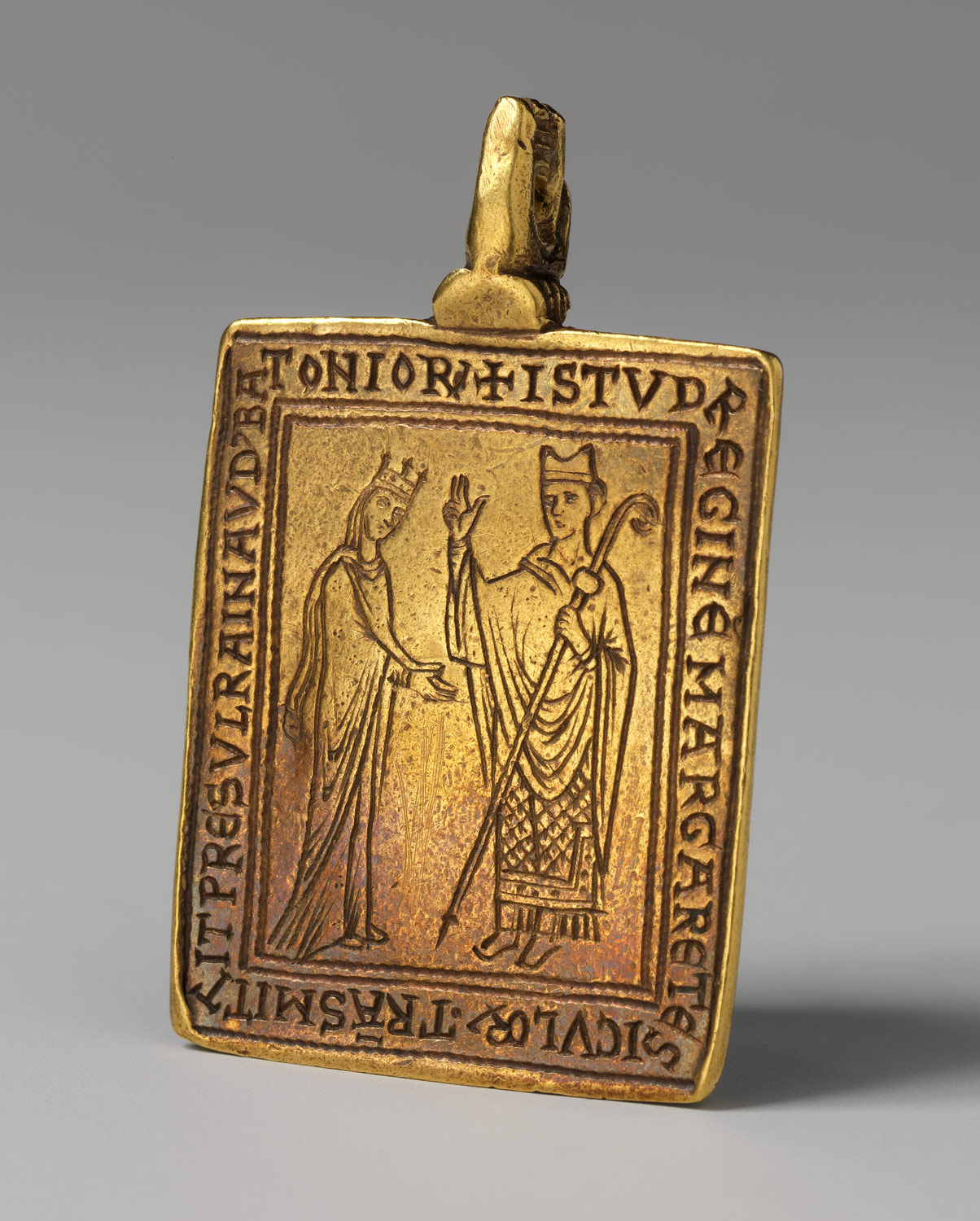
This artifact is called the "Reliquary Pendant with Queen Margaret of Sicily Blessed by Bishop Reginald of Bath". This pendant is created out of gold and and roughly 2in x 1.25in x 0.25in. Such a beautiful pendant was created approximately between 1174 and 1177 AD by an unknown artist, however it was sent by Bishop Reginald of Bath to Queen Margaret of Sicily. The inscription around the borders state, "From the blood of Saint Thomas the Martyr, from his clothes having been dyed by his blood. From the skin, from the small garment, from the hood, from the shoe, [from the] shirt. From the skin, from the small garment, from the hood, from the shoe, [from the] shirt" (The Met).
This "Saint Thomas the Martyr" is in fact Thomas Becket, the archbishop of Canterbury who was brutally murdered by the knights of King Henry II. It was most likely given to the queen as a present when her son married the daughter of King Henry II in 1177. Queen Margaret of Sicily was the daughter of the Holy Roman Emperor thus making her Catholic (Wiki Margaret of Sicily). This pendant, to her would have meant a lot. To the queen it most likely held a meaning of her to keep her faith, despite whatever hardships she may face through her son's marriage to the daughter of Henry II. The bondage of such families would have surely created some kind of conflict because of their differentiating views of religion's role in their rule. However, the familiar nature surrounding the pendant would have driven the meaning of the queen remaining true to her Catholic faith home, without a doubt.
Furthermore, the fact that the blood of a martyr was in the necklace makes it an extremely powerful and sacred piece of jewelry. So much so that it could contend with the altar in a Catholic church, because it too houses a religious artifact, oftentimes of a martyred saint. The style of placing the blood of the martyr in the necklace was intended to give her the strength to be holy and pure, which is the same reason they are placed under Catholic altars.
Also, the unknown artist purposely made the stylistic choice to have the inscription of what the pendant contains circle/enclose the image of the queen getting blessed a bishop. They did this because the inscription shows that the queen is blessed and important to the Catholic Church, and that the message this pendant is conveying should always influence her and encompass her world. Although this may seem controlling, by having the image of the queen being blessing in the center of the pendant, it also enforces the idea that this queen was one of the most important people to the catholic church, and that the church, symbolized by the bishop's blood and inscription of the blood, was supporting her from all sides.
Finally, there is the most visible and clear evidence of the idea that the pendant was intended to give Queen Margaret the strength to maintain her faith through the image on the front. This is clearly an image of Queen Margaret being blessed by Reginald the Bishop. This is known because of the telltale crook and hat held by a bishop, the raised 2 fingers, and the crowned woman. The choice to depict such a scene, that may have never actually happened in real life, is to symbolize the idea that the queen has now been blessed because she wears the pendant. Blessed to lead a life of strength to be like the martyr, St. Thomas, and stand up for her faith.
When looking at the context of the piece, the importance of this pendant and what it symbolizes becomes drastically more clear. At this time, the Catholic Church greatly feared losing their power and influence in Europe, despite the fact that in many areas they controlled the majority of land, money, and nobility. They feared losing this more so during this time period than others prior to the 1170s because the Church had just witnessed one of their Archbishops be brutally murdered by orders of a King. Since they feared an increase of attacks against them, the pendant was a symbol of the Church trying to keep a strong relationship with a member of royalty.


Nice job thinking about the WHAT-HOW-and-WHY- you were careful to not just jump into a larger understanding, instead thinking about what you see on the surface and then connecting that to the context.
ReplyDelete